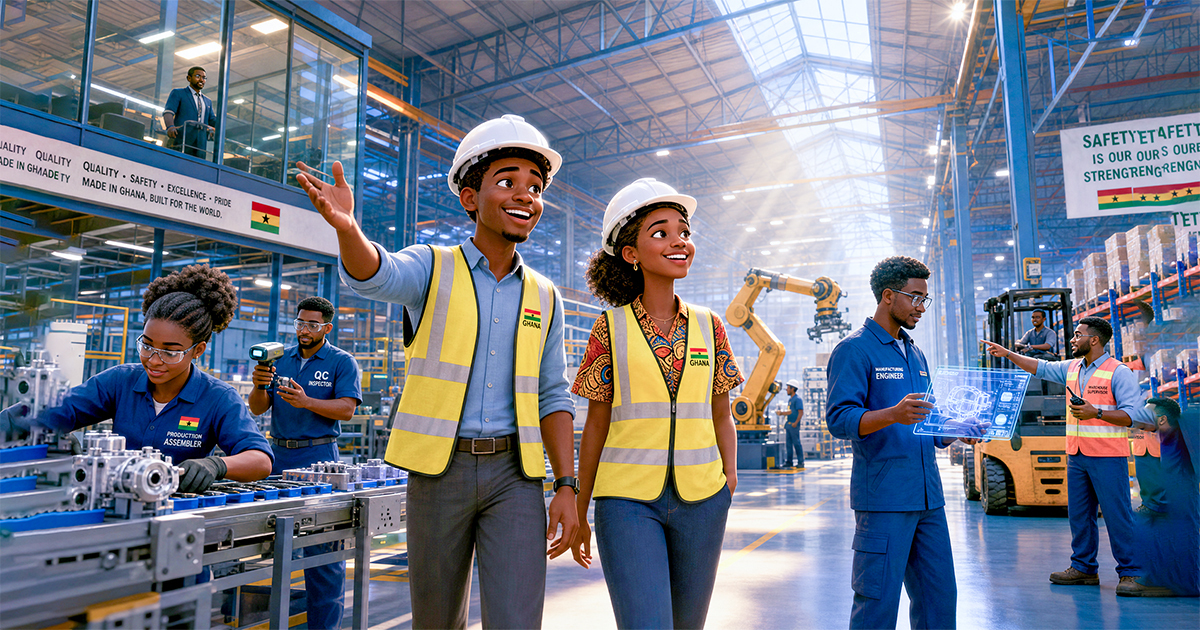
If you are exploring careers in the manufacturing industry, understanding the different tiers of roles, their hierarchy, and the necessary qualifications can help you map out a successful professional pathway. This article will outline 11 career paths and where to start with each.
Table of Contents
1. Production Assembler
Assemblers build products by joining component parts with hand tools, power tools, and semi-automated machinery. This is a foundational, entry-level role that typically requires a Senior High School Certificate. Most companies provide on-the-job training for this role.
2. Sales Development Lead
Sales Development Leads in the manufacturing industry spearhead B2B outreach to identify new market opportunities, pitch manufacturing capabilities to prospective industrial clients, and build the initial pipeline for the sales team. This is a mid-level commercial and growth role. This role requires a Bachelor’s degree in Business, Marketing, or a technical field related to the manufactured product, combined with 2–4 years of proven B2B sales experience.
3. Quality Control (QC) Inspector
Quality Control Inspectors in the manufacturing industry examine raw materials and finished products to ensure they meet exact company blueprints, safety metrics, and regulatory standards. Imagine a sachet water factory that needs a quality control inspector to ensure the water produced meets standards and is safe to drink. This is an entry- to mid-level operational role. Requires a Diploma, HND and Degree combined with specialised experience. To also become a quality control inspector, you also need professional certifications, such as the ASQ Certified Quality Inspector (CQI), which are highly advantageous.
4. Manufacturing Engineer
Manufacturing Engineers design, implement, and improve the actual physical production systems. They focus on minimising waste, reducing costs, and scaling output. This is a specialised mid-level professional role. To work as a manufacturing engineer, a Bachelor’s degree in Mechanical, Industrial, or Manufacturing Engineering is standard.
5. Production Supervisor
Production Supervisors in the manufacturing industry oversee day-to-day operations on the factory floor, manage shifts, guarantee compliance with labour safety standards, and keep production schedules on track. This is a mid-level management role. This position often requires a Bachelor’s degree in Business or Management, though many advance through 3–5 years of hands-on manufacturing experience.
6. Industrial Maintenance Technician
These technicians diagnose, repair, and perform preventive maintenance on complex factory machinery, robotics, and electrical systems to minimise downtime. This is a skilled mid-level technical role. This role requires a degree in Industrial Maintenance, Mechatronics, or Electronics, or equivalent vocational technical training.
7. Supply Chain / Logistics Coordinator
They manage the movement of materials into the facility and the distribution of finished goods to vendors or clients, balancing inventory levels along the way. This is a mid-level administrative and operational role. This role typically requires a Bachelor’s degree in Supply Chain Management, Logistics, or Business Administration.
8. EHS (Environmental Health and Safety) Specialist
EHS specialists design and enforce safety programs to protect factory workers from hazards and ensure the facility complies with environmental regulations, including requirements of the Ghana Standards Authority. This is a mid- to senior-level compliance role. This role requires a Bachelor’s degree in Occupational Health and Safety, Environmental Science, or Engineering.
9. Plant Manager
The Plant Manager is entirely responsible for a manufacturing facility’s overall performance, including budgeting, staffing, output, and profitability. This is a senior-level leadership role.
Requirements include a Bachelor’s degree in Engineering or Business (an MBA is highly preferred) along with 7–10+ years of progressive manufacturing leadership experience.
10. Director of Operations
The Director of Operations oversees high-level strategy across multiple manufacturing facilities, driving technology adoption (such as AI and automation) and aligning global production with corporate goals. This is an executive-level corporate role. This role requires a Master’s degree, such as an MBA or an Engineering Management degree, and 10+ years of executive-level industrial experience.
11. Warehouse Supervisor
This position positions you to oversee day-to-day inventory operations, manage warehouse staff, ensure safe forklift and loading dock practices, and coordinate inbound raw materials and outbound shipments. This is a mid-level logistics management role. This role typically requires a degree in Logistics or Supply Chain Management, though it is often 3+ years of hands-on warehouse experience.
By understanding the range of career paths available in the manufacturing industry from entry-level roles like Production Assembler to executive positions such as Director of Operations, you can make informed decisions about your professional growth. Each role offers unique challenges and opportunities, and investing in the necessary education and experience can open doors to advancement.
Begin your career in the Manufacturing Industry with Jobberman. Apply now.