
Key takeaways:
According to the 2026 Ghana Job Market Report, employers are seeking candidates with revenue and data skills.
Commercial and data analysis skills have become increasingly vital in the job market due to macroeconomic pressures that require companies to drive internal sales and use data to make informed, strategic decisions.
The report reveals that 54% of listed roles require a degree, but leaders and employers who want to drive their companies forward need to align degrees with practical demonstration of sales acumen and data skills.
Revenue and data skills have become employer priorities according to The 2026 Ghana Job Market Report by Jobberman Ghana and Nexford University. While general administrative experience and niche technical tools remain relevant, the market clearly demonstrates that organizations are paying a premium for talent capable of acquiring customers and measuring performance. This guide breaks down what the data reveals, why this talent need exists, and how hiring managers can adapt their talent acquisition strategy to build a high-performing workforce.
Table of Contents
What the 2026 Ghana Job Market Report Data Reveals
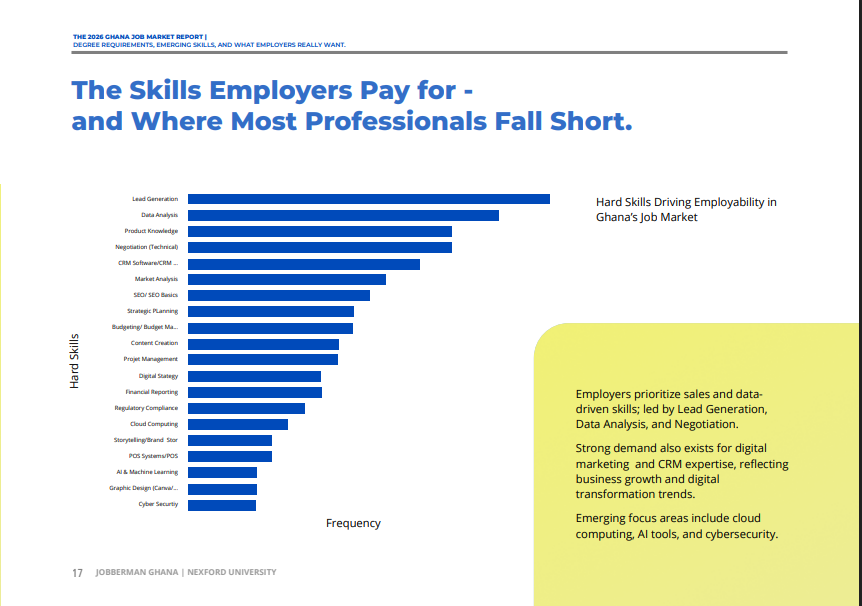
The findings reveal a clear hierarchy in the skills employers prioritize.
Commercial skills emerged in the report as the most sought-after category, with lead generation standing out as the single most requested hard skill across all job listings. This highlights that, for employers, running a business is not merely an exercise; the goal is to generate profit. As a result, hiring top talent who can identify leads, close deals, and contribute directly to revenue growth is both inevitable and essential.
The report further explains that in every effective sales structure, product knowledge sits at the center. It enables sales professionals to negotiate confidently and maximize every revenue-generating opportunity. However, sales success is not only about generating revenue but also about securing repeat purchases. This makes strong customer service and effective customer service management systems essential.
According to the report, customer service is the link that protects and sustains the revenue generated by sales. This explains why employers are increasingly listing customer service vacancies that require experience in using CRM software. Companies that understand this invest in talent that recognizes the importance of customer needs and is prepared to respond to them effectively. In this context, CRM can be compared to a business’s memory bank: it stores every customer interaction, preference, and concern, helping companies understand their customers better and respond with the right solutions at the right time.
Beyond generating leads, closing deals, and managing customer relationships, businesses must also be able to interpret the data these activities produce. Imagine having access to all the data from your CRM, analytical tools, or sales reports, yet being unable to draw strategic insights from it. What is the essence of having data if it does not inform business decisions? What is the data revealing about the business? Is the business failing, or is it making a profit? Where should costs be reduced, and where should investments be made?
These are the kinds of questions businesses ask in order to make informed decisions that can propel them to the next level. When data is properly understood and interpreted, it provides a clear path toward solutions, strategies, and actionable guidelines. This is why the report shows that data analysis expertise has become a key talent acquisition necessity for employers, following right behind Lead Generation. Well-interpreted data drives business growth.
At the bottom of the graph, baseline governance skills such as budgeting, financial reporting, and regulatory compliance continue to anchor current hiring needs. By contrast, emerging technical skills like cloud computing, AI, machine learning, and cybersecurity are gaining relevance but still account for a much smaller share of job openings. This suggests that while companies are paying attention to digital transformation trends, they are still prioritizing the core governance functions that keep their businesses running.
Why Commercial and Data Skills Matter Today in the Job Market
Commercial and data skills have become essential to employers, and this can be attributed to the demand pressure from macroeconomic factors;
High Monetary Policy Rate (MPR): With the Bank of Ghana’s monetary policy rate (Interest rate) at 14.0%, businesses find it expensive to borrow from commercial banks for expansion. This means businesses that seek expansion through cheap loans must now put in extra effort to generate cash internally, making commercial skills essential for driving new sales and converting leads into a steady revenue stream.
Exchange Rate Volatility: In 2022, the Ghanaian cedi devalued against the US dollar, peaking at over 50% (Mensah, 2022), resulting in higher costs of living, imports, exports, and services. This left businesses no choice but to increase prices. This is an instance where companies would seek to hire a commercial analyst who can build flexible pricing models, track real-time margin adjustments, and assist the business in making boardroom strategic decisions; otherwise, they will leave their customers to competitors. This goes to say that when employers hire, they hire to resolve key business problems like this.
Other reasons for the rise in hiring for commercial and data skills include;
- Data-Driven Decision Making: Organizations generate more data through digital touchpoints and CRM software than ever before. However, raw data without interpretation leads to poor operational choices. Employers need candidates who can translate spreadsheet data into actionable business strategy in order to avoid these poor operational choices.
The Employer Action Plan: How Businesses Can Adapt Their Hiring Strategy
To attract and retain professionals who possess both commercial drive and data literacy, leadership teams should apply the following four strategies:
Redesign Job Descriptions for Measurable Outcomes
Traditional job descriptions often list vague responsibilities (e.g., “Responsible for managing sales pipelines”). This change will require your job listings to reflect actual execution skills; for instance, “Analyze weekly pipeline data in CRM software to identify drop-off points and refine lead generation targeting.”
Target the Full-Stack Professional
Based on the report, employers should look for candidates who combine interpersonal persuasion and negotiation skills for sales roles with quantitative skills, depending on their business needs. During interviews, test for both halves of the skill spectrum:
- Test Commercial Execution: Ask candidates to walk through their exact lead generation process, from prospect identification to contract negotiation.
- Test Analytical Capability: Provide candidates with a sample dataset or performance dashboard during the assessment phase and ask them to highlight three key trends and actionable next steps.
Upskill Internal Staff on Data Literacy
Finding external candidates who excel at both commercial strategy and data skills can be challenging. Invest in structured training programs to upskill your existing team in CRM software, data interpretation, and pipeline management rather than waiting for a single candidate who possesses every skill.
Align Degree Requirements with Practical Execution
With over 54.5% of listed roles requiring a university degree per the 2026 Job Market Report, there is a need to align the certification with the skill. Use degree requirements as a baseline, but evaluate candidates based on their practical sales portfolio and data execution skills.
Next Steps for Business Leaders
- Audit Your Current Job Openings: Review your active job descriptions to ensure they emphasize revenue generation through sales and business development, as well as data capabilities, rather than generic administrative tasks.
- Standardize Skill Assessments: Incorporate a practical data-interpretation task into your interview process for sales, marketing, and operations candidates.
- Review Internal Training Budgets: Allocate resources to train mid-level managers on data analysis tools and customer relationship management systems
According to the 2026 Ghana Job Market Report, employers are prioritizing data analysis, lead generation, CRM software, negotiation, and technical skills.
The 2026 Ghana Job Market Report shows that over 54.5% of advertised roles on Jobberman Ghana required a Bachelor’s degree as a minimum requirement. Degrees are viewed as a stratum that demonstrates problem-solving and foundational business skills needed for business growth.
According to the 2026 Ghana Job Market Report, Sales, Marketing, and Accounting roles accounted for over 65% of overall job listings. Notably, these functions directly impact every business’s bottom line.