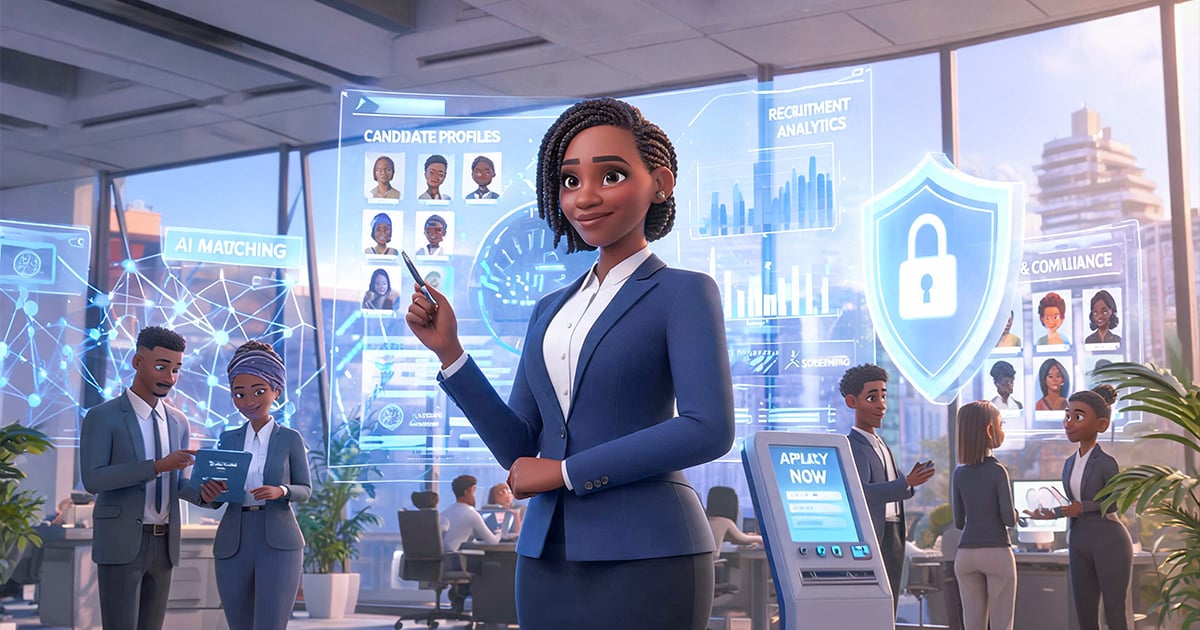
AI in HR: What Ghana’s Data Protection Act Means for Your Hiring Tools
Data Protection has become essential in the AI era. Human resource departments in Ghana are rapidly transitioning from manual operations to digital ecosystems,
Written by Benedicta Enyonam Oklu, Community Marketer at Jobberman Ghana.
Data Protection has become essential in the AI era. Human resource departments in Ghana are rapidly transitioning from manual operations to digital ecosystems, with Artificial Intelligence (AI) serving as a primary driver of recruitment and workflow efficiency. However, top voices at the first edition of the Jobberman Ghana HR & CEO Wave Summit 2026 emphasise that operational efficiency must not compromise data compliance. This guide details the safeguards HR leaders need to leverage AI responsibly while protecting sensitive candidate and employee data.
Table of Contents
Why Does AI Conflict With Data Privacy Laws?
Artificial Intelligence relies on large volumes of data. To screen CVs, predict employee retention, or analyse performance metrics, AI tools require access to extensive personal information. This is where a data-intensive approach directly conflicts with strict regulatory frameworks.
Consider a scenario already playing out in offices across Accra: a recruiter, pressed for time, pastes fifty CVs into a free public chatbot and asks it to shortlist candidates. Within seconds, the names, phone numbers, addresses, and employment histories of 50 people have been transferred to servers outside Ghana on a platform with no data processing agreement, without any candidate’s knowledge or consent. No one intended to break the law. The efficiency gain was real. So was the breach.
What Law Governs Employee Data Privacy in Ghana?
All corporate data collection, processing, and storage within the country are legally bound by the Ghana Data Protection Act, 2012 (Act 843). Act 843 explicitly mandates that personal data be processed lawfully and transparently, with the clear, unambiguous consent of the data subject (the employee or job applicant).
Uploading CVs, medical histories, or banking details into third-party AI platforms or cloud-based software may result in unauthorised data transfer or processing violations under Act 843 if appropriate security measures are not implemented.
How Can HR Teams Use AI Without Breaching Act 843?
To maximise operational performance while avoiding significant legal penalties from the Data Protection Commission (DPC), HR directors should implement a dual-focus governance strategy.
1. Anonymise Data Before It Enters Any AI System
Prior to inputting historical employee records or large volumes of applications into AI machine-learning models for trend analysis, learning, screening or research, HR teams must remove these but is not limited to, full names, phone numbers, residential addresses, Ghana Card numbers, SSNIT numbers, Taxpayer Identification Numbers (TINs), driver’s license and passport numbers, dates of birth, and bank account or mobile money details.
2. Vet AI Vendors Before You Sign
The legal responsibility for employee data privacy resides with the employer rather than the technology provider. When auditing AI platforms for recruitment or predictive analytics, HR leaders should require clear documentation regarding data hosting locations, security and encryption standards, and, critically, whether the vendor uses customer data to train its models. Choose enterprise-grade tools whose contracts commit, in writing, that your data will not be used for model training, and verify this in the data processing agreement rather than relying on marketing claims.
Critical Compliance Check: Act 843 says,
a data controller shall take the necessary steps to secure the integrity of personal data in the possession or control of a person through the adoption of appropriate, reasonable, technical and organisational measures to prevent (a) loss of, damage to, or unauthorised destruction; and (b) unlawful access to or unauthorised processing of personal data.
This becomes especially important when AI tools host data on servers outside Ghana. HR departments must ensure that AI tools use cloud servers that meet robust security standards and encryption protocols, and that an active data protection supervisor is maintained within the organisation, as stated clearly on page 33 of the Act.
The conversation was had years ago that management decisions should be made by a human. Data, AI, and tools are enablers for humans, so that when something goes wrong, there is a human responsible. So this conversation about we’re automating, so humans are not in that, is one of the big risks, and we shouldn’t run with it, quite frankly. Data, AI, that should enable a human to make a decision so that we are sure that our lives, or at least our organisations, are not run by machines. -Ethel Cofie
Ethel Cofie, CEO & Founder of Edel Technology Consulting speaks on AI Governance at the HR & CEO Wave Summit 2026
Risk: Fully automated processing may result in unmonitored algorithmic bias, systematically excluding local talent due to flawed parameters.
Safeguard: Final decisions regarding hiring, termination, and promotion should remain subject to human review to ensure ethical alignment and complete transparency.
What Should HR Leaders Do First? A Four-Step Checklist
Step 1: Register with the Data Protection Commission: Ensure your organisation is fully registered with the Ghana Data Protection Commission and up to date as a Data Controller.
Step 2: Appoint a Trained Data Protection Supervisor:
The supervisor conducts a gap analysis to ensure your organisation’s practices align with the principles of the DPA.
Step 3: Update your privacy notices: After identifying the gaps, action plans or internal policies need to be in place to put things in order; employee (HR team) training follows. This also meansrevising internal employee handbooks and your job application portals to clearly state how AI tools process applicant data and which categories of tools are in use.
Step 4: Secure explicit, specific consent: Before processing applicant data through automated screening, tell candidates exactly which data points will be processed and by which tool, and obtain their unambiguous opt-in consent. Then process only those data points, and nothing beyond what was consented to. Data minimisation is not just good practice under Act 843; it is the principle regulators check first.
Frequently Asked Questions
Is it legal to use AI for recruitment in Ghana?
Yes. No law prohibits it, but for the introduction of new technologies such as AI, facial recognition, or other innovative systems, a DPIA (Data Protection Impact Assessment) needs to be done to identify reasonably foreseeable internal and external risks to personal data and establish an appropriate safeguard (because their decisions and actions are automated). There is no explicit statutory provision in Act 843, though, but the Data Protection Commission of Ghana expects organisations to conduct one in situations like this.
Can I paste CVs into ChatGPT, Gemini or other AI chatbots?
Not into consumer versions. Doing so transfers personal data to third-party servers without a data processing agreement and typically without candidate consent. Use enterprise tools with contractual data protections, and anonymise the data first.
Who is liable if an AI vendor mishandles our candidate data?
The employer. Under Act 843, the organisation that collects the data remains responsible as the data controller, regardless of which vendor processes it.
Does my organisation need to register with the Data Protection Commission?
Yes. Any organisation that collects or processes personal data in Ghana must register with the DPC as a data controller and keep that registration current.
The Bottom Line
Achieving a high-efficiency HR department does not require sacrificing candidate trust or violating national regulatory frameworks. The ultimate takeaway is that technological progress and data privacy are not opposing forces; they are deeply interdependent.
The most resilient organisations in Ghana will be those that view data privacy not as a bureaucratic hurdle, but as a core competitive advantage. By establishing strict ethical governance, insisting on transparent vendor partnerships, and keeping human judgment at the centre of automated systems, HR leaders can confidently leverage AI’s speed while maintaining absolute corporate integrity and legal compliance.