Artificial intelligence has quietly become part of everyday HR. It screens CVs, supports employee queries, analyses performance data and powers software that many organisations use without giving much thought to the technology behind it.
Yet while AI adoption continues to accelerate, governance has not kept pace. Many organisations are introducing AI into HR processes before deciding who is accountable for its decisions, how employee data should be handled or what safeguards should exist when technology influences hiring and people management.
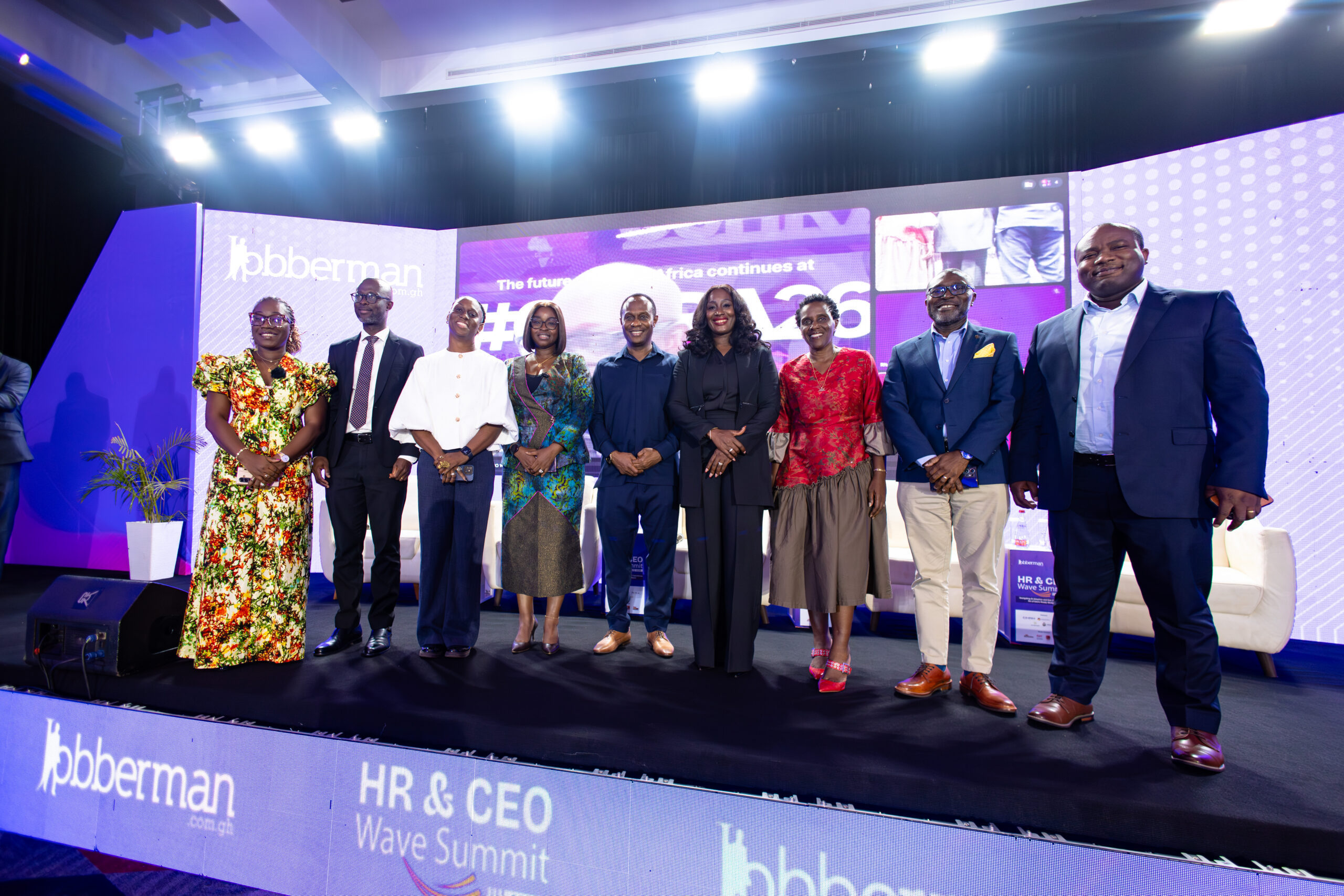
That tension defined the opening panel discussion at the HR & CEO Wave Summit 2026, hosted by Jobberman Ghana. Bringing together leaders from technology, corporate HR and the public sector, the conversation moved beyond whether organisations should adopt AI. Instead, it examined a more pressing question: are organisations prepared to manage AI responsibly?
Table of Contents
Is AI being enabled faster than it’s being governed?
One point attracted little disagreement throughout the discussion. AI has already arrived in the workplace.
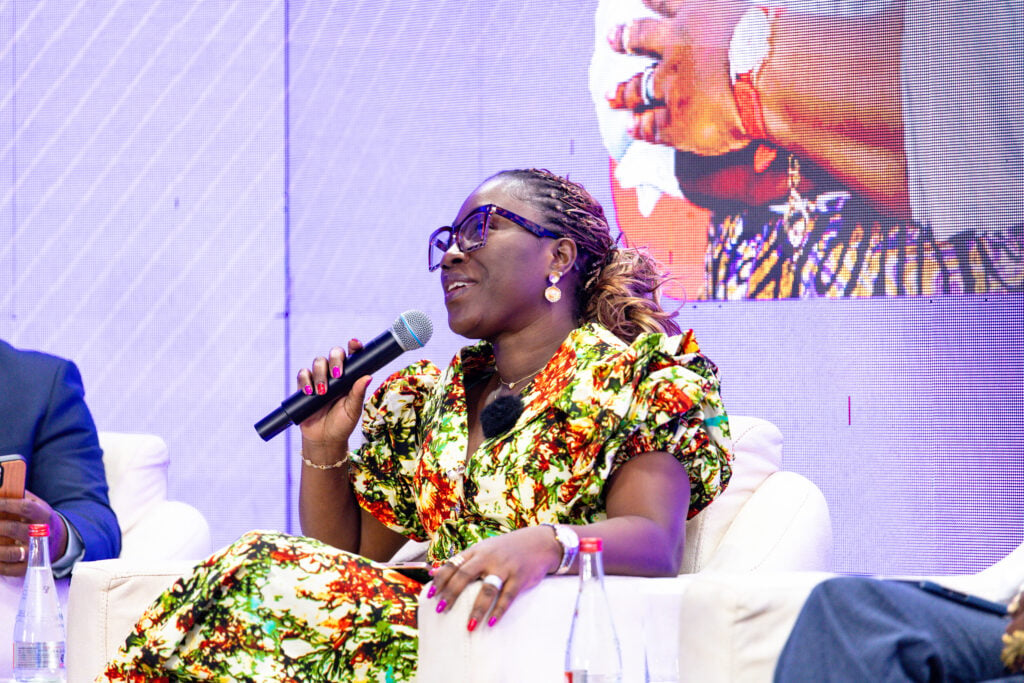
Ethel Cofie observed that organisations are becoming “AI-enabled faster than they are being AI-governed.” It is a distinction that matters. The technology is advancing quickly, but the policies, accountability structures and oversight needed to manage it responsibly are developing far more slowly.
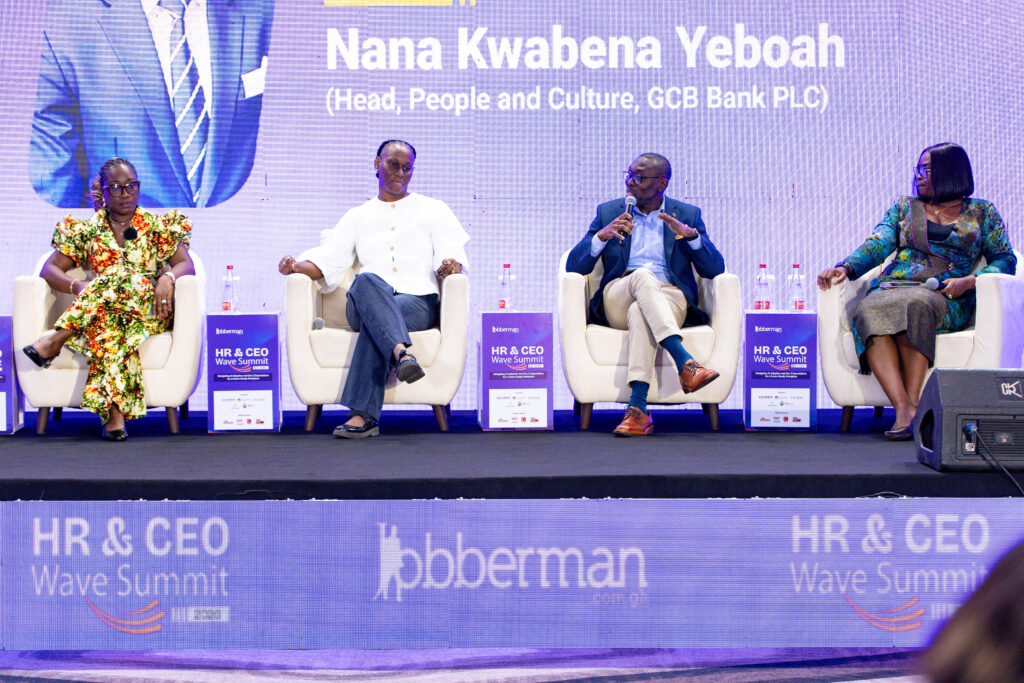
Nana Kwabena Yeboah reinforced that view by arguing that the issue is no longer whether people are using AI. The real question is whether organisations have the governance needed to use it without exposing themselves to unnecessary risk.
Together, their comments challenged a common assumption. AI governance is often treated as something organisations should think about after implementation. The panel suggested the opposite. Governance should shape adoption from the beginning.
Has AI in HR moved past the “buzzword” stage?
Before organisations can govern AI effectively, they first have to acknowledge where they are in the adoption journey. On that point, the panel agreed that AI has moved well beyond being a buzzword.
Deborah Asmah reflected on how quickly the conversation has evolved. A few years ago, many organisations equated simple automation or chatbots with artificial intelligence. Today, the widespread availability of generative AI tools has changed that.
“We have kind of democratised this usage with our ChatGPTs, et cetera, and most people in the room already understand, on some level, what generative AI tools can do.”
Awareness, however, has not translated into strategy.
An interesting thread emerged as the discussion continued.
Deborah Asmah argued that organisations frequently approach AI from the wrong direction. Rather than identifying a business challenge and determining whether AI is the right solution, many begin by searching for AI tools.
That mindset, she suggested, encourages adoption without sufficient strategic thinking.
Mrs Adjoa Van Vicker highlighted another dimension of the problem. Many organisations do not recognise how much AI is already embedded in the software they use every day. Recruitment platforms, payroll systems and workforce management tools increasingly rely on AI capabilities, yet few organisations have updated their policies to reflect that reality.
These two observations reinforce one another. Organisations cannot govern technology they have not fully acknowledged, and they cannot develop meaningful policies if AI adoption begins with curiosity instead of business need.
Which HR functions has AI transformed the most?
The discussion also revealed that AI’s impact varies across HR.
Recruitment has experienced the greatest transformation because it involves large volumes of structured information. Screening applications, matching candidates and scheduling interviews are all tasks that benefit from automation.
Functions such as compensation and performance management are following a similar path because they rely heavily on measurable data.
Employee relations tell a different story.
As Nana Kwabena Yeboah noted, trust, empathy and judgement remain central to managing people. Technology can support those conversations, but it cannot replace them. HR’s responsibility extends beyond processing information. It involves understanding context, resolving conflict and building relationships, areas where human judgement remains indispensable.
The implication is clear. Organisations should not expect AI to transform every HR function equally. They should instead understand where automation adds value and where human involvement must remain central.
What’s actually holding organisations back from proper AI governance?
If AI governance is lagging, the discussion suggested that the problem begins earlier than many organisations realise.
Mrs Adjoa Van Vicker observed that many organisations are already using AI without consciously recognising it. Recruitment platforms, payroll systems and other workplace technologies increasingly rely on AI capabilities, yet they are often treated as ordinary software rather than systems that require oversight.
- Awareness of existing use: “If you ask somebody in the public sector, for instance, oh, do you use AI at work? They’re likely going to tell you, no, not yet. But we are using it one way or the other.” Many organisations are already running AI-powered applicant tracking or payroll software without formally recognising it as “AI in use.”
- Policy: “There are no policies that tell us which ones we can use, what kind of employee data you can collect, store or use. And there’s no clarity around who is actually responsible for it.” The lack of an institutional compliance policy leaves employee data vulnerable.
- Trust: Employees need confidence that AI is working for them, not against them. “Is this here to help me or is it here to replace me? Is the data that I’m putting out there safe?” she quoted.
For many employees, responsible AI is not just about technology. They need to understand how decisions are made, how their data is protected and whether human judgement remains part of the process. Mrs Van Vicker concluded that these challenges are interconnected rather than independent. As organisations become more aware of where AI is already being used, they can develop clearer policies, strengthen employee trust and build governance that keeps pace with adoption. “All these gaps are closeable. HR must create that awareness.” She emphasized.
What are the biggest risks of AI in HR and how can organizations reduce those risks?
As organisations rely more heavily on AI, the risks become harder to ignore.
Ethel Cofie pointed to algorithmic bias as one of the most significant concerns. AI systems learn from historical data. If that data reflects existing inequalities, technology can reproduce those patterns in recruitment, promotion and performance decisions. She cited the well-documented case of a hiring platform that surfaced lower-paying jobs for women due to bias in its training data.
The next risk addresses the frequently asked question – “Is AI going to take my job?” To that she responded affirmatively, “Yes. It’s going to take, at the very least, the jobs of entry-level folks, however it’s going to sharpen your high producers, your senior people.”
Does that mean the solution is to remove AI from HR especially at the entry level?
No, HR leaders are to ensure that every AI-assisted decision can be understood, questioned and reviewed by people.
Transparency, she argued, allows organisations to identify bias before it affects employees. Human oversight ensures accountability when technology makes recommendations that carry real consequences.
“Too many organisations treat AI as an opaque “black box” input in, decision out. Implementing auditable, explainable AI is what allows a human to catch bias before it becomes a promotion, a rejection, or a policy that quietly disadvantages a group of employees.” she explained
She further cautioned against removing humans from decision-making entirely when employing AI tools: “Data, AI, and tools are enablers of the human so that when something goes wrong, there is a human responsible… we shouldn’t run with [automation] quite frankly.” A human-in-the-loop approach is vital.
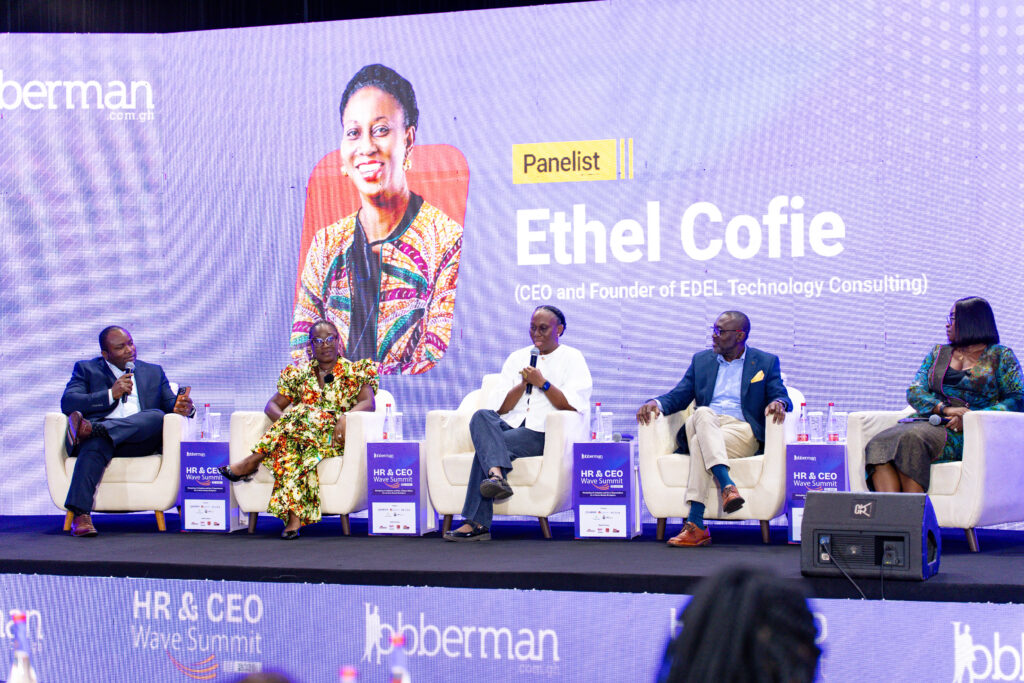
The Conversations HR Leaders Should Be Having Now
The panel opened by asking whether AI adoption is moving faster than AI governance. By the close of the discussion, the answer had become evident.
The challenge facing organisations is no longer technological capability. It is organisational readiness.
That readiness requires more than investing in new tools. It demands clear policies, stronger accountability, greater transparency and leaders who understand both the opportunities and the limitations of AI.
Technology will continue to reshape HR. Whether it strengthens organisations or creates new risks will depend less on the tools and more on the quality of the decisions surrounding their use.
FAQs
AI adoption in HR and the ethical, responsible governance and regulatory frameworks needed to manage it, featuring Ethel Cofie, Deborah Asmah, Adjoa Van Vicker, and Nana Kwabena Yeboah, moderated by David Wilson.
That organisations are adopting AI and machine learning faster than they govern them, leaving gaps in corporate policy, algorithmic accountability, and employee trust.
Recruitment and selection (talent acquisition), largely due to the high volume of applications per vacancy and the need for automated CV parsing.
Build transparency, auditability, and explainable AI systems into AI-assisted decisions, so a human can review and catch machine bias before it affects a real employment outcome.
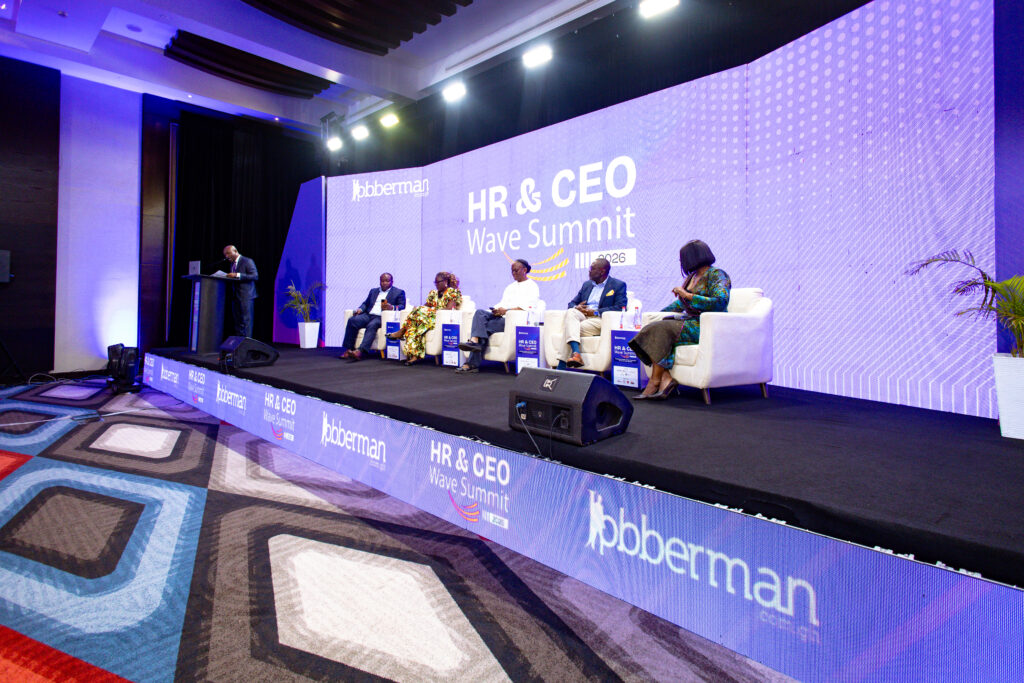
Date & Venue: 14th May 2026, Mövenpick Ambassador Hotel, Accra
Session: Panel Discussion 1- AI Adoption in HR: Ethical and Responsible AI Governance
Moderator: David Wilson, Director of Operations, Global Conference on Human Resources in Africa (GCHRA)
Panellists: Ethel Cofie (CEO & Founder, EDEL Technology Consulting), Deborah Asmah (COO, Npontu Technologies), Mrs Adjoa Van Vicker (Director, Human Capital and General Services, Petroleum Commission Ghana), Nana Kwabena Yeboah (Head of Human Resources, GCB)