For years, the dominant question around artificial intelligence and the labor market has been simple: Will AI take my job?
It is a completely reasonable concern. However, for employers and professionals trying to understand how artificial intelligence is reshaping the workforce, a far more useful question is: What could AI mean for your specific role?
That distinction matters because jobs are not single, indivisible blocks; they are collections of tasks. AI does not need to eliminate an entire occupation to fundamentally change what that job requires. It can automate routine tasks, accelerate complex ones, and completely alter the skills required to perform what remains.
According to the World Economic Forum’s Future of Jobs Report 2025, which surveyed over 1,000 employers representing 14 million workers:
- 40% of core skills are expected to change by 2030.
- 170 million new jobs are projected to be created.
- 92 million jobs may be displaced.
- Net impact: A global creation of 78 million net new jobs.
The data points to a reality far more nuanced than headlines suggest: work isn’t simply disappearing, it is evolving.
Table of Contents
1. Deconstruct the Role: Start With Tasks, Not Job Titles
Consider the day-to-day responsibilities of a corporate recruiter. A recruiter’s workload typically includes:
- Reviewing CVs and candidate profiles
- Writing and updating job descriptions
- Sourcing candidates and outbound outreach
- Scheduling interviews and managing applicant communications
- Strategic consultation with hiring managers
AI tools can already streamline or automate nearly all of these activities.
Does this make the recruiter obsolete? Not at all. Instead, it shifts their time and judgment toward higher-value human activities like relationship building, cultural assessment, and strategic talent advising.
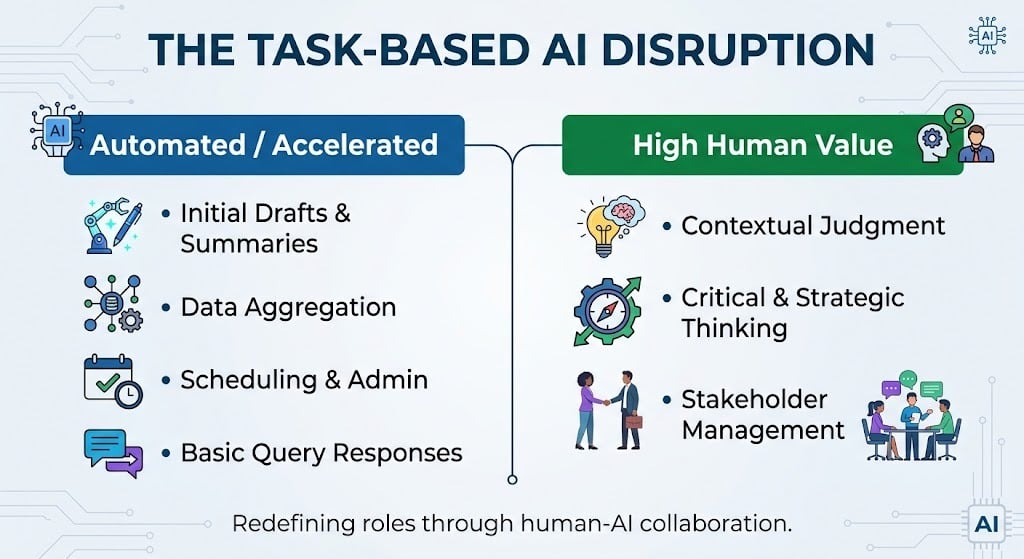
This pattern holds true across virtually every business function:
- Marketers use AI to draft baseline content and analyze campaign sentiment.
- Data Analysts leverage AI to generate code and summarize massive datasets.
- Customer Service Teams rely on AI bots for routine FAQs, reserving human agents for escalated, high-empathy issues.
- Sales Representatives deploy AI to research prospects and generate tailored pitch decks.
Technology isn’t dividing jobs into binary categories of “survivors” and “victims” it is reorganizing the tasks within almost every role.
2. Hard Tech Skills vs. Soft Skills: Why Human Judgment Wins
It is easy to assume that as demand for technical capabilities grows, traditional human skills become less relevant. The data proves the exact opposite.
The World Economic Forum highlights AI, big data, cybersecurity, and technological literacy among the fastest-growing technical skills through 2030. However, the top-ranking operational skills expected to surge in demand include:
- Creative thinking & analytical thinking
- Resilience, flexibility, and agility
- Curiosity and lifelong learning
- Leadership and talent management
Knowing how to generate content or code with AI is helpful; knowing what to ask, how to verify accuracy, and when human oversight must step in is what sets elite professionals apart.
Key Takeaway for Jobseekers: Your long-term employability depends less on whether your field is “safe from AI” and more on your ability to develop domain expertise alongside technological adaptability.
3. Focus on AI Readiness, Not Just AI Certifications
The sudden influx of generative AI tools has created widespread professional anxiety, a feeling that you must learn every new platform to stay competitive.
Effective AI literacy should always serve your specific career domain:
- Sales professionals don’t need to understand how large language models (LLMs) are built. They need to master AI tools that streamline prospect research, pipeline analysis, and client communication.
- Project managers don’t need to write code. They need to understand how AI tools can track deliverables, predict resource bottlenecks, and automate status reports.
Instead of collecting generic AI certificates, target the specific tools transforming your target role and integrate them into your daily workflow. AI should enhance your professional development, not replace it.
4. The Employer’s Playbook: Reskilling vs. Workforce Reduction
This structural shift poses an equally critical question for talent acquisition leaders and executives: What defines a qualified candidate today?
If the software and tools powering a role change every 12 to 18 months, rigid technical requirements lose their value quickly. Instead, hiring managers must evaluate a candidate’s foundational capability paired with their capacity for continuous learning.
The WEF Future of Jobs Report reveals two distinct strategies emerging among employers:
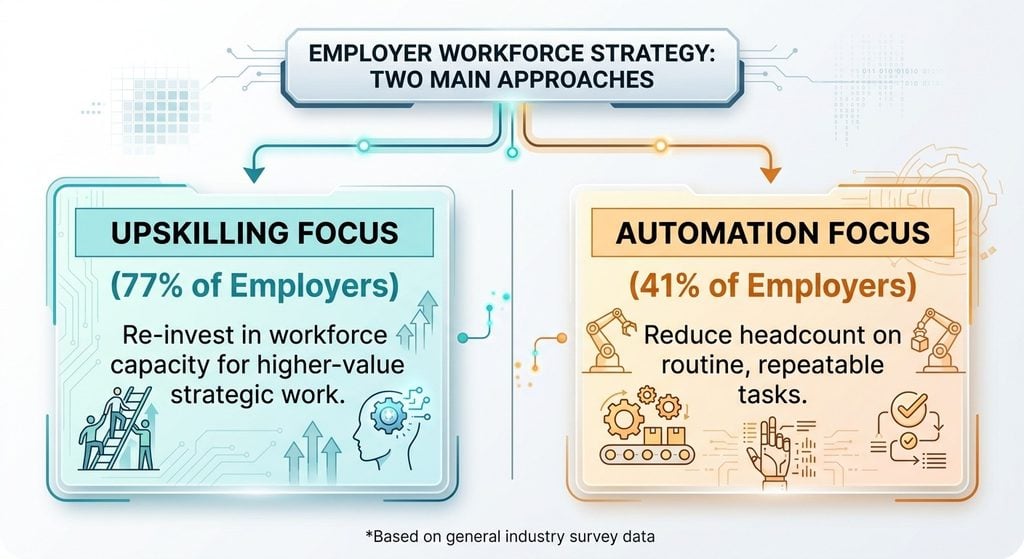
Forward-thinking organizations treat AI as a strategy for talent expansion, reallocating freed-up employee bandwidth toward innovation, client relationships, and business growth.
What Does AI Mean for Your Career Moving Forward?
AI’s impact on your career path isn’t a single event, it is an ongoing process. Practically, this means:
- Faster Execution: Administrative and repeatable tasks will take a fraction of the time.
- Shift in Value: Purely operational execution will yield lower value, while strategic oversight, interpretation, and stakeholder communication will command a premium.
- Emergence of Hybrid Roles: New specialized positions blending domain expertise with AI orchestration will continue to open up across industries.
Unsure How AI Is Changing Your Specific Field?
The impact of artificial intelligence varies significantly by industry, job function, and career stage.
👉 Take our 3-minute survey to receive a personalized breakdown of how AI disruption applies directly to your role—and the exact steps you can take today to stay ahead.