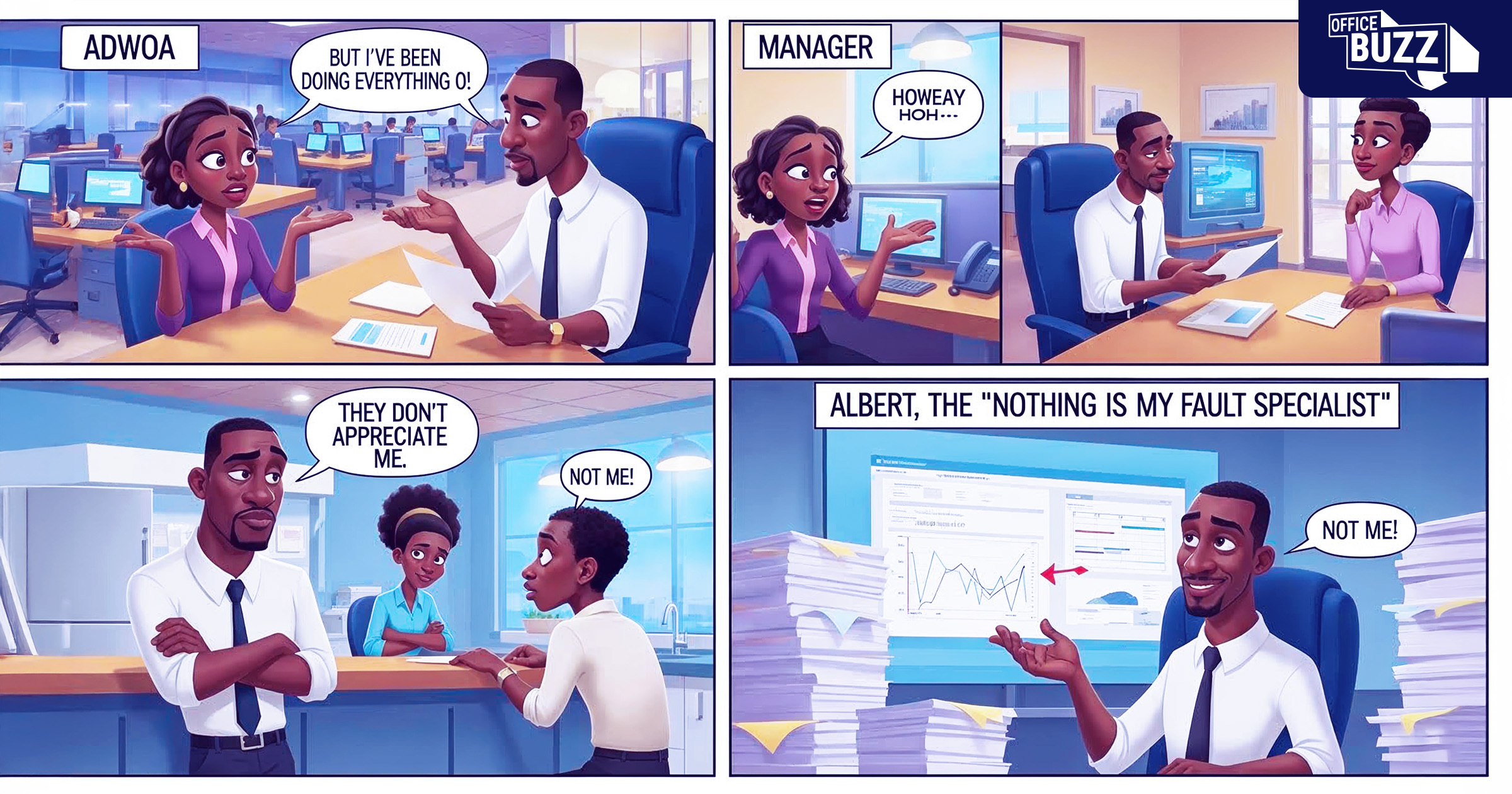
It’s performance review season again, and across Ghanaian offices, something interesting is happening. People are suddenly extra polite, emails come with “Kindly” and “Please” more than usual, and even Kwaku from Finance, who walks typically like he owns the building, is now greeting security with two hands.
But there’s one group of employees who struggle the most during this season:
The ones who find it difficult to take feedback. If you’ve worked in any Ghanaian office long enough, you’ve definitely met one or been one at some point.
Table of Contents
Meet Adwoa Serwaa, the “But I Tried My Best” Employee
Adwoa from Customer Experience walked into her review with confidence. She expected praise, maybe even a surprise raise. But when her manager mentioned that she needed to improve her documentation, her smile vanished.
“Ei, but I’ve been doing everything o!” she protested.
Her manager took a deep breath. The review had barely started. Adwoa didn’t hear “improve your documentation.” What she heard was: You didn’t work hard.
It wasn’t true, but because she took it personally, she couldn’t accept the simple truth: she could do even better.
Then There’s Mensah, the “Silent Angry” Employee
Mensah from IT is calm by nature. But during feedback season, he becomes quieter than usual. His manager said, “Your technical skills are strong, but your communication needs work. Sometimes the team doesn’t understand your updates.”
Instead of listening, Mensah nodded politely, left the room, and told the entire office kitchen, “They don’t appreciate me.” But the truth was simple:
Mensah didn’t communicate clearly—and it was affecting the team’s work.
And Then There’s Albert, the “Nothing Is My Fault” Specialist
Albert from the Purchasing & Supply department always has a perfectly packaged explanation for everything, just never responsibility.
“Albert, we noticed delays in procurement approvals last quarter.”
“Oh, that one wasn’t me, ooo.. the vendors were dragging their feet.”
“There were also a few errors in the inventory reconciliation.”
“Hmm, the system was acting strangely that day.”
“We also need you to communicate updates more proactively with the operations team.”
“Ah, but they too don’t check their emails!”
By the end of the review, Albert had expertly shifted blame in all directions except inward. And with that, the chances of improvement stayed exactly where they were: pending.
And Of Course, Angela, the “Immediate Defender”
Angela from Sales approaches every feedback session the same way she approaches a demanding client, ready to counter every point. “Your sales numbers were decent, but you need to improve your conversion rate.
“Ei, but most of the leads were cold!”
“Your report submissions were late this month.”
“Oh, that one network was misbehaving!”
“You also need to collaborate more with the Sales Support team.”
“But I’m the one who helps everyone chase their clients!”
By the end of the review, Angela had defended every issue so passionately that nothing sank in, and nothing improved.
Why Do Some Employees Struggle With Feedback?
Because feedback, especially negative or corrective feedback, touches the ego.
In Ghanaian culture, where many of us grew up hearing “Well done” only on special occasions, feedback can feel like an attack rather than guidance.
But here’s the secret most people miss:
Feedback isn’t about what you didn’t do well.
It’s about what you can become if you adjust.
Moral of the Story: Feedback is a Gift (Even When It Stings Like Pepper)
Performance reviews aren’t designed to disgrace you. They’re meant to:
- Help you grow.
- Show you blind spots.
- Improve your skills.
- Strengthen team collaboration.
- Prepare you for bigger roles.
Taking Feedback Well Is a Professional Superpower. Here’s how to handle it like a true pro.
1. Listen Fully Before Reacting
When someone gives you feedback, your first instinct may be to defend yourself. “That’s not what happened!” or “I only did that because…”
Resist that urge. Stay quiet, stay present, and listen till the very end. Most misunderstandings happen because people react before they hear the complete picture. Listening fully sets the tone for maturity and earns you respect.
2. Ask for Specific Examples
Vague feedback is hard to act on. So ask: “Could you share an example?” or “When did this happen?” Real examples help you understand the context, spot patterns, and identify what you can actually change. Clarity turns personal feedback into practical action.
3. Ask for Guidance on How to Improve
Feedback isn’t just about what went wrong; it’s about how to get better.
Ask questions like: What would you recommend going forward? How can I meet expectations better? This shows maturity, coachability, and commitment to growth. Leaders love working with people who want to learn, not just defend.
4. Separate the Feedback From Your Identity
This one is tough but crucial.
Feedback is about your performance or output, not your character, personality, or potential.
When you detach your self-worth from the critique, you’re able to evaluate it more logically, without taking it as an attack. Strong professionals understand that you can be good and still have areas to improve.
5. Reflect and Take Action
Feedback is only powerful when applied. Take time to process what you heard. Ask yourself:
- “What can I start doing?”
- “What should I stop doing?”
- “What should I continue doing?”
Then make changes, even small ones. Consistent action turns feedback into results, and results turn you into someone people trust for bigger responsibilities.
Mastering feedback isn’t just a workplace skill; it’s a career advantage. The professionals who rise fastest aren’t always the smartest or the loudest; they are the ones who learn, adapt, and evolve. When you listen without defensiveness, seek clarity, ask for direction, and act on what you know, you transform feedback from uncomfortable to powerful. Remember: every piece of feedback is a bridge to your next level. Walk across it with confidence, humility, and purpose.
This is the Office Buzz! Work, Culture and Everything in between!
Share this article with that colleague who needs to read this.