
Imagine you are the head of talent at a bank and for a month you have not being able to find the right head of IT candidate; the next question would be, “how do i hire the right tech talent in Ghana?” It could be that he or she is looking for the candidate in a direct “Tech pool” but it’s not always that way. Some tech talents are hiding in the Fintech and Insurance space. This is what the Ghana 2026 Tech & Financial Talent Benchmark Report addresses. Focusing on finding tech talents under tech talent pool could cost you the right candidate. But this report isn’t just about knowing the numbers but knowing how to pivot to find that one candidate.
We analysed 1,008 live job listings across Ghana’s Banking, Finance & Insurance and IT & Telecoms sectors in 2026 to find out where tech and specialist talent is genuinely scarce, what it costs to retain, and where the realistic pipelines already exist. One number stood out above the rest: 93% of Software & Data listings in our sample are filed under “IT & Telecoms.” Only 7% sit under “Banking, Finance & Insurance.” Job portals classify roles by function, not industry, so the financial sector’s own tech hiring is hiding inside a category banks rarely search.
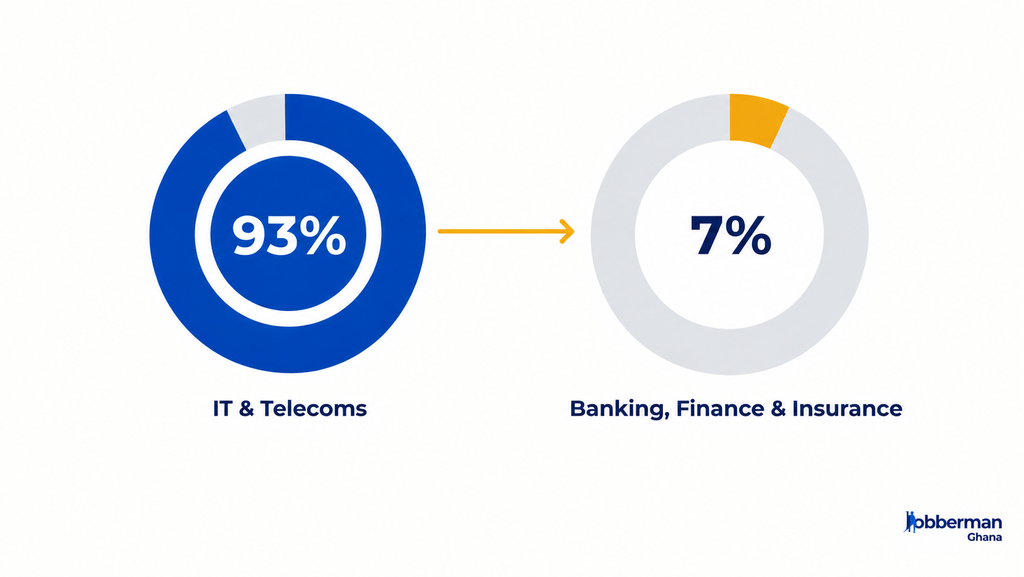
That single classification gap explains a pattern we kept finding in the data: banks and fintechs are competing for the same candidates while each assumes the other isn’t really in the fight.
Below are three of the four signals we found. The fourth, and every supporting figure behind it, is in the full benchmark report.
Table of Contents
The shortage is real – just narrower than “tech talent shortage” suggests
Compliance, risk, cybersecurity and data roles show a genuine, quantifiable shortage in Ghana’s market. Of the 1,008 listings we analysed, only 20 to 25 carried a named cybersecurity, AML, risk, or data-science title.
That scarcity carries a premium. Software & Data is the only function in our sample with a genuine top-end salary cluster: GHS 3,600 to 4,800 per month. Locally, that premium holds. Regionally, it does not — it converts to roughly USD 220 to 300 per month, against USD 1,500 to 2,900 for comparable roles in Lagos or Nairobi.
For any employer competing beyond Ghana’s borders for the same candidates, that gap is a retention risk hiding in plain sight.
Your degree requirement is screening out the people filling the gap
A Bachelor’s degree remains the predominant screening requirement — 56% of listings in our sample asked for one. But employer practice is already more flexible than that headline figure suggests: 25.8% of listings accept a Diploma, HND, or SSCE, and under 2% request an MBA or MSc.
The real constraint employers are fighting is applied, mid-level, hybrid experience — not a shortage of people holding postgraduate qualifications.
Engineering & Technology is the clearest entry point into this market. The function has the lowest applicant competition of any major category in our sample, indicating a credible, lower-competition path toward the premium Software & Data roles above.
Banks and Fintechs are already competing for the same candidates
Ghana’s fintech sector expanded fast through 2025: transaction value grew 50.8% year-on-year to GH¢4.54 trillion, with 63 licensed entities now operating. Technology platforms scale through code rather than headcount, so that growth does not translate into a matching rise in hiring. Instead, dozens of competing platforms end up fighting over the same pool of software and data professionals that banks also need.
Most hiring data misses this entirely. As the 93%/7% split in our introduction shows, job portals classify roles by function, not industry — so financial-sector tech hiring is routinely counted as generic “IT,” not “Banking.” We also found direct evidence of the pattern: employers in both microfinance and payments posted technical roles under general IT listings rather than finance-specific ones.
We covered the early signs of this shift in Rethinking Talent Acquisition in Banking, Finance and Insurance. This benchmark is the data behind that story.
What the full benchmark adds
The data also maps a fourth signal: a realistic upskilling ladder for jobseekers, built on how two functions actually behave in Ghana’s market where the lowest-competition entry point lies, and what it takes to progress from it to roles that pay a premium. That pathway and the comparison behind it are reserved for the full report.
What’s inside the Ghana 2026 Tech & Financial Talent Benchmark Report:
- The named titles behind Ghana’s specialist-role shortage, benchmarked against global cybersecurity and compliance scarcity data
- The complete education-requirement breakdown across all 1,008 listings; degree, diploma, HND and SHS shares.
- The full fintech-vs-banking classification data, with named examples of how postings get miscategorised
- The realistic upskilling ladder from entry-level to premium specialist roles
- Four strategic takeaways built directly for 2026 hiring and retention planning
Get the full benchmark
Download the complete Ghana 2026 Tech & Financial Talent Benchmark Report, free and see exactly where your hiring strategy needs to catch up with the market.
Yes. The report is a free resource from Jobberman Ghana, built to help Banking, Finance & Insurance and IT & Telecoms employers plan their 2026 hiring and retention strategy.
The findings come from a point-in-time snapshot of 1,008 live job listings across Ghana’s Banking, Finance & Insurance and IT & Telecoms sectors in 2026, combined with national labour statistics, regulatory filings, and global benchmarks through a three-tier data triangulation framework.
Both. The report treats Banking, Finance & Insurance and IT & Telecoms as a single, overlapping talent market — which is the central finding: fintechs and traditional financial institutions are increasingly drawing from the same candidate pool.
HR and Talent Acquisition leaders, hiring managers, and executives at banks, insurers, fintechs, and technology employers in Ghana who are setting 2026 hiring, compensation, or retention strategies.