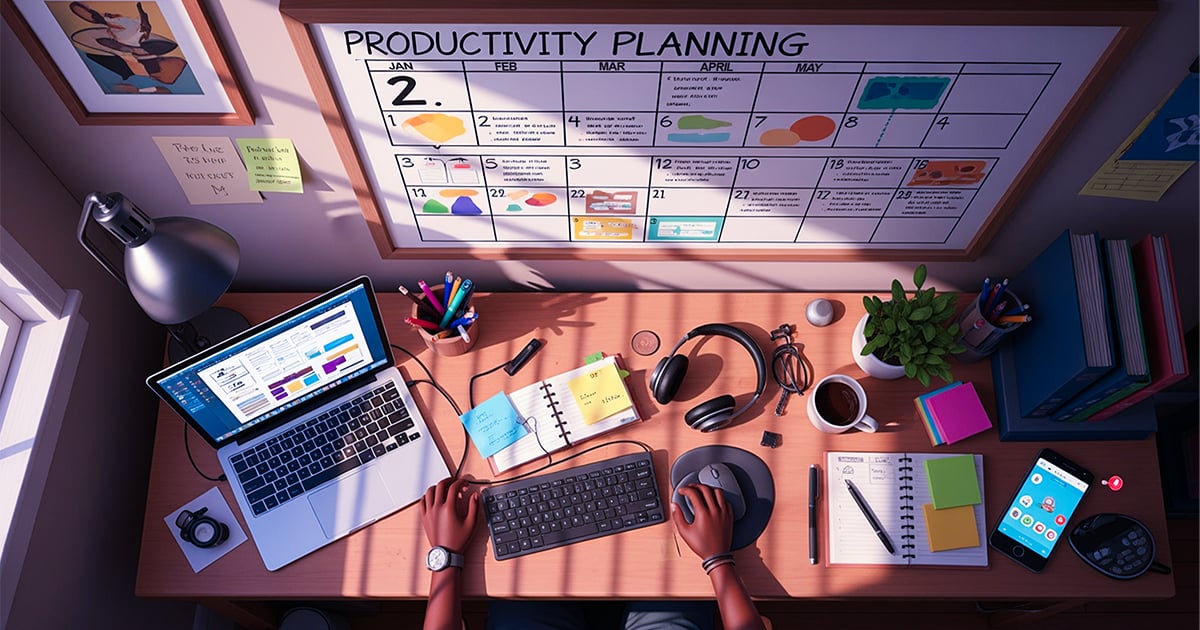
Is the “flexibility” of your remote workers actually the silent killer of their performance? While working from home is the new standard, many teams struggle with a lack of structure that drains efficiency. To enhance your productivity as a remote worker, you must move beyond simple task lists and implement dedicated workspaces, strict time blocking, and synced communication protocols. By focusing on Deep Work sessions rather than “hours logged,” you can transform a distracted home environment into a high-output professional hub.
Discover five strategic ways to enhance your productivity as a remote worker.
Table of Contents
1. Designate a Functional “Zone of Genius”
The primary killer of focus for remote workers is environmental blending. If you work in the same spot where you relax, your brain struggles to enter a state of flow. Successful workspace optimisation requires physical segregation, such as using a specific room or a partitioned corner where no other activities occur. You should also prioritise an ergonomic setup with a support chair and an external monitor at eye level to prevent physical fatigue. Finally, use focus items, like a specific desk lamp, to signal to your brain that you are actually in a workplace.
2. Implement the “Eat the Frog” Morning Routine
Productivity is often decided in the first hour of the day. Optimised workflows suggest that you, as a remote worker, should tackle your most complex task, the “Frog”, immediately to avoid the creeping drain of decision fatigue. You can achieve this by choosing your primary task the night before to eliminate morning hesitation. It is equally important to practice digital fasting by avoiding email or Slack for the first thirty minutes after you arrive at work.

3. Utilise Time-Blocking and the Pomodoro Technique
To-do lists are passive, but calendars are active. To improve your output as a remote worker, you must assign every task a specific time slot rather than relying on a vague list of chores. Start by scheduling Deep Work blocks of 90 minutes (depends on you) for uninterrupted, cognitively demanding tasks, with all notifications silenced. For administrative work like emails and filing, utilise the Pomodoro rhythm of 25-minute focus intervals followed by 5-minute breaks to lower cognitive switching. Always ensure you leave a 10–15-minute buffer between scheduled meetings to prevent mental exhaustion and allow for proper processing time.
4. Optimise Your Digital Communication
As a remote worker, you’d mostly rely on tech. You must streamline your digital environment to favour focus over constant pings. According to recent studies on distributed team management, communication is required, not optional, for all remote workers. Teams should prioritise a first-things-first approach, using tools like Loom or Notion to share updates that don’t require a live meeting. Establishing a “green light” rule ensures that Slack or Teams is used only for urgent queries, while complex strategy is moved to project management software.
5. Leverage Project Management Frameworks
As a remote worker, it is important to centralise all remote tasks in tools like Asana, Trello, or Jira. By keeping all documentation and communication within these platforms, you reduce the “hidden work” of searching for files across various emails and chat threads. This consolidation can save you up to tons of time that would otherwise be lost to administrative friction. When you and every other remote worker on your team know exactly where to find their next priority, the need for micromanagement vanishes, and individual autonomy thrives.
By grounding your daily routine in a dedicated workspace, prioritising high-leverage tasks through time-blocking, and utilising digital collaboration tools to streamline communication, you effectively eliminate the friction that typically slows down distributed teams. True efficiency as a remote worker isn’t found in working longer hours, but in protecting your cognitive energy. As you implement these strategic frameworks, you will transform the inherent flexibility of remote work into your greatest competitive advantage, ensuring consistent, high-quality output without the risk of burnout.
FAQs
The most effective method is time-blocking. By assigning specific tasks to specific hours on your calendar, remote workers eliminate the distraction of choice and create a structured environment that mimics the focus of a professional office.
Focus on output over hours. Use digital collaboration tools to track milestones and hold brief, daily “stand-up” meetings to identify roadblocks rather than monitoring “active” status icons or counting hours logged.