Table of Contents
Key Takeaways
- “The future of work is being shaped by both technology and people. Organisations that will thrive are those that can adopt innovation while remaining intentional about their people strategy.”– Hilda Nimo Tieku
- AI is reshaping the job market by becoming a helpful tool for marketers, brand managers, video editors, copywriters and many others.
- While a traditional brainstorming session will require your team to spend hours, an AI-centric organisation will use generative AI to brainstorm a campaign in less than an hour, thereby increasing efficiency.
The State of the AI Job Market in 2026
According to UNICEF, the job market was about experimentation in 2024, whereas 2026 is the year of Observed Exposure. This refers to the actual, real-time evidence of how AI is impacting jobs today, as opposed to theoretical predictions. And according to recent studies by the World Economic Forum, nearly 60% of jobs in some economies are now exposed to AI, not necessarily for replacement but for significant task augmentation.
The Shift from Entry-level Roles to Strategic Occupations
AI is currently eroding some traditional entry-level roles, such as junior data entry or basic customer service. In 2026 and beyond, the market will shift toward “Destination” roles: higher-wage positions that require strategic thinking, human judgment, empathy, and AI orchestration skills.
The 2026 Skills Pivot
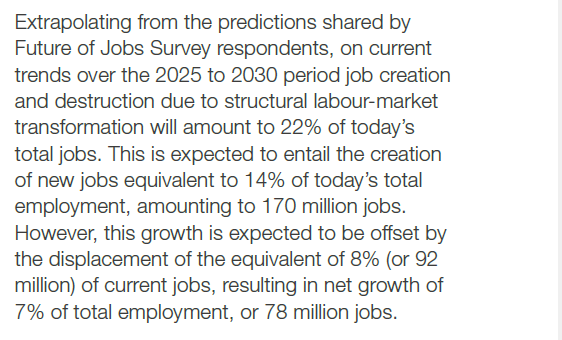
According to the World Economic Forum’s latest findings on workforce transformation, the “entry-level” is no longer a place for simple tasks. 40% of employers plan to reduce workforces in areas where AI automates routine tasks (Data Entry, Basic Admin). 170 million new roles are being created that require AI Orchestration, managing the AI output rather than doing the manual work. This report is also supplemented by the State of AI in Africa Report 2025, where there is a high demand for technical skills in Machine learning, data analytics and theoretical AI.
The Rise of the “Human-Touch” Model
For machines or AI, it is all about execution, data sorting, and drafting, and, as your team uses AI, your customers and users will always want that authentic human feel: ethical judgment, relationship management, and high-stakes decision-making. Jobs aren’t going to disappear because AI is now in a boom; they are, rather, unbundled into human versus machine workflows.
Sector-Specific Transformation
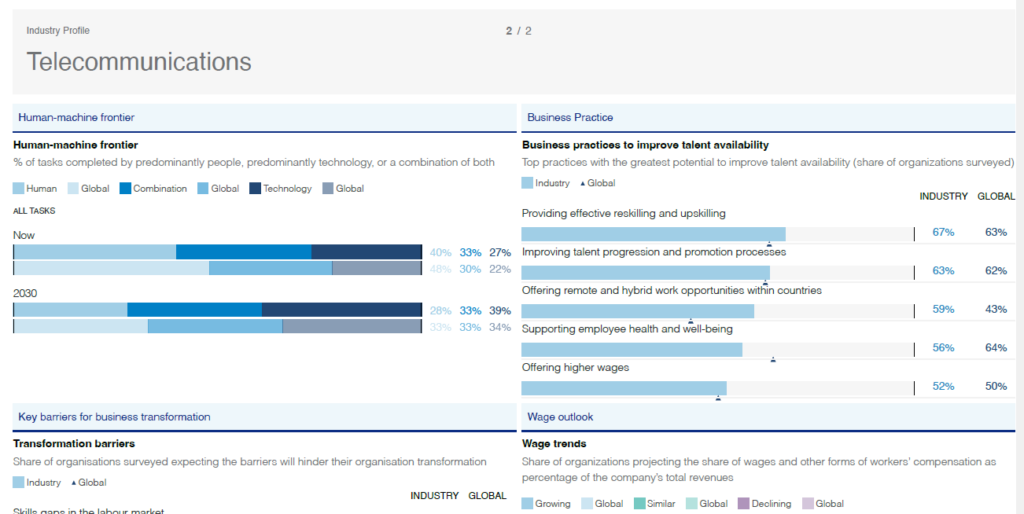
The impact of AI is not uniform; different industries are experiencing divergent shifts in job creation and required expertise. For instance, the World Economic Forum infographic illustrates the digital transformation in the Telecommunications industry through 2030. It breaks down the shift into three key areas:
- Impact on Jobs: It shows a net positive outlook, with 6.4% growth in the workforce. While traditional roles are declining, they are being offset by a 16.2% emergence of new, tech-driven positions.
- Technological Drivers: AI and Big Data lead as the top technologies being adopted by 85% of companies, followed closely by cloud computing and encryption.
- The Skills Pivot: The chart highlights that Analytical Thinking and Technological Literacy are the most critical skills for the future, noting that 44% of core skills for workers in this sector will need to change by 2030 to keep pace with these advancements.
The End of the Degree-Only Era
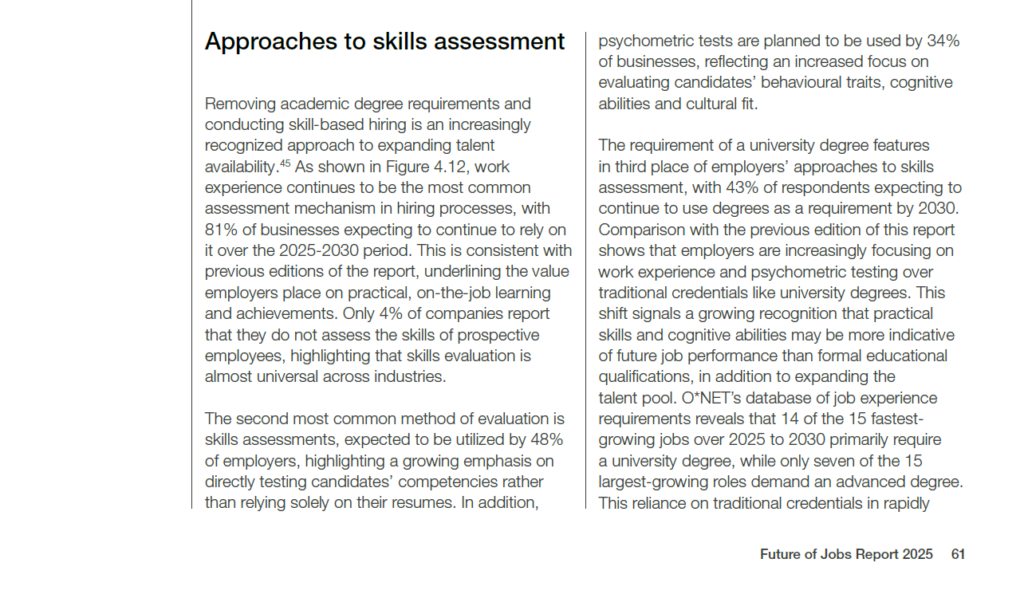
To bridge the widening skills gap, the job market is moving toward a “skills-first” approach rather than relying solely on traditional education.
According to the World Economic Forum Report, if the global workforce were 100 people, 59 would need significant training by 2030 to stay relevant. While 43% of employers still use university degrees, 48% are now prioritising direct skills assessments, and 81% rely on work experience to evaluate candidates.
Conclusion: Navigating the African AI-Driven Workforce
The transformation of Africa’s job market in 2026 is not merely about technological adoption; it is a fundamental shift in how we value human expertise. As AI takes over routine execution, eroding traditional “gateway” roles and automating nearly 60% of tasks in advanced economies, the focus for leadership must pivot toward AI Orchestration and the preservation of the “Human-Touch”. Organisations that thrive will be those that transition from a degree-centric hiring model to a skills-first strategy, prioritising analytical thinking, empathy, and strategic judgment.
Understanding these structural shifts is one thing, but implementing them is another. This is why attending the HR and CEO Wave Summit is critical.
The future of work is being shaped by both technology and people. Join this year’s HR and CEO Wave Summit organised by Jobberman Ghana as we discuss “AI Adoption in HR; ethics and responsible AI Governance in the workplace. ” This summit isn’t just a networking event; it is a critical strategic briefing for the African labour market. Save your seat today!