
Ask a Head of Talent at a Ghanaian bank where their tech talent hiring competition comes from, and most will point to other banks. The data says otherwise.
We analysed 1,008 live job listings across Ghana’s Banking, Finance & Insurance and IT & Telecoms sectors in 2026 to find out where tech and specialist talent is genuinely scarce, what it costs to retain, and where the realistic pipelines already exist. One number stood out above the rest: 93% of Software & Data listings in our sample are filed under “IT & Telecoms.” Only 7% sit under “Banking, Finance & Insurance.” Because job portals classify roles by technical function rather than employer industry, the financial sector’s own tech hiring is effectively hiding inside a category banks rarely monitor. This single classification gap explains why commercial banks, lenders, and payment providers frequently compete for the exact same candidates while operating under the assumption that they are in different markets.
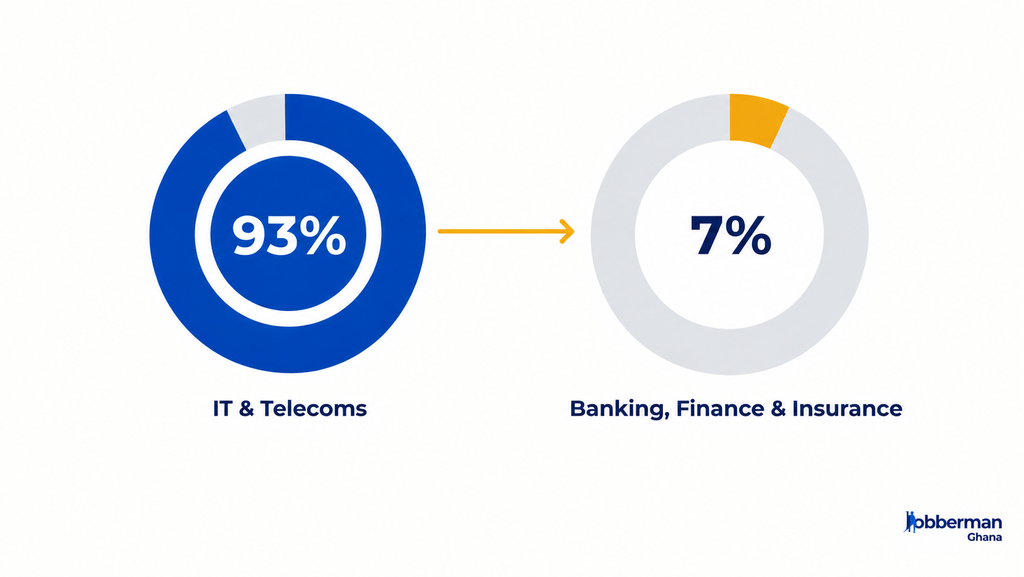
That single classification gap explains a pattern we kept finding in the data: banks and fintechs are competing for the same candidates while each assumes the other isn’t really in the fight.
Below are three of the four signals we found. The fourth, and every supporting figure behind it, is in the full benchmark report.
Table of Contents
The shortage is real – just narrower than “tech talent shortage” suggests
Compliance, risk, cybersecurity and data roles show a genuine, quantifiable shortage in Ghana’s market. Of the 1,008 listings we analysed, only 20 to 25 carried a named cybersecurity, AML, risk, or data-science title.
That scarcity carries a premium. Software & Data is the only function in our sample with a genuine top-end salary cluster: GHS 3,600 to 4,800 per month. Locally, that premium holds. Regionally, it does not — it converts to roughly USD 220 to 300 per month, against USD 1,500 to 2,900 for comparable roles in Lagos or Nairobi.
Geography no longer shields Ghanaian employers from international remote hiring. For local organizations, this pay differential represents a major retention risk hiding in plain sight.
Your degree requirement is screening out the people filling the gap
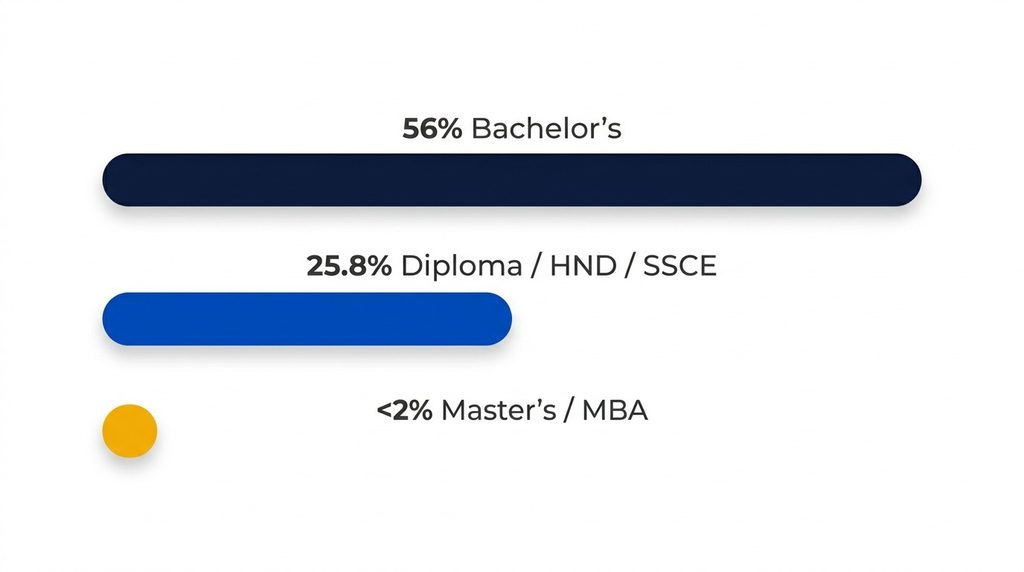
The primary bottleneck for employers is not a lack of candidates with postgraduate credentials, but a shortage of professionals with applied, mid-level experience. Employers screening purely for four-year degrees are unnecessarily cutting themselves off from a viable talent pool.
Engineering & Technology is the clearest entry point into this market. The function has the lowest applicant competition of any major category in our sample, indicating a credible, lower-competition path toward the premium Software & Data roles above.
Banks and fintechs are already competing for the same candidates
Ghana’s fintech sector expanded fast through 2025: transaction value grew 50.8% year-on-year to GH¢4.54 trillion, with 63 licensed entities now operating. Technology platforms scale through code rather than headcount, so that growth does not translate into a matching rise in hiring. Instead, dozens of competing platforms end up fighting over the same pool of software and data professionals that banks also need.
Most hiring data misses this entirely. As the 93%/7% split in our introduction shows, because job postings are categorized by functional role rather than industry sector, this cross-industry competition remains largely invisible in standard market reports. Employers in both payment services and microfinance regularly post core technical roles under general “IT” categories rather than finance-specific classifications, masking the true extent of sector overlap.
We covered the early signs of this shift in Rethinking Talent Acquisition in Banking, Finance and Insurance. This benchmark is the data behind that story.
What the full benchmark adds
One of the most striking findings in our benchmark report is the complete absence of specialist digital postings from the insurance sector.
Out of 1,008 listings, only four came from insurers, and all four were for general IT infrastructure and maintenance roles:
- IT Officer
- Internal Audit Assistant (IT / Systems Audit)
- IT Infrastructure Manager
- Systems Administrator / IT Manager
Not a single insurance job listing named an actuarial, underwriting, data analytics, or cybersecurity title. This indicates that insurance sector hiring is either happening entirely off the open market or digitally lagging behind banking and fintech—meaning their digital transformation ambitions are not yet reflected in public recruitment channels.
Strategic Action Plan for 2026/2027 Hiring
Based on the Ghana 2026 Tech & Financial Talent Benchmark Report benchmark data, employers in Ghana should adapt their talent strategies around five core principles:
- Source Off-Market for Specialist Roles: Treat risk, compliance, cybersecurity, and data roles as premium hires—source them via direct search before they hit open boards.
- Benchmark Against Remote Pay: Evaluate technical compensation against international remote offers, not just local competitors.
- Drop Unnecessary Degree Filters: Expand recruitment to include applied, sub-degree (Diploma/HND) pathways.
- Monitor Cross-Industry Competition: Recognize that banks and fintechs are competing for the exact same talent pool.
- Build Internal Pathways: Create structured upskilling programs to transition junior engineering staff into scarce specialist positions.
Get the full benchmark
Download the complete Ghana 2026 Tech & Financial Talent Benchmark Report, free and see exactly where your hiring strategy needs to catch up with the market.